Finance

Money
Education and costs
In the Netherlands, school costs change based on the school type.
For little kids in primary school (basisschool), it’s free. But, parents might need to pay for some things like pencils and books.
For bigger kids in secondary school (voortgezet onderwijs), it’s also free. But, parents have to buy some school things.
For students in higher school (hoger onderwijs), they must pay money. Here’s what they might pay:
University: Dutch students pay around several thousand euros a year. Students from other countries pay a lot more.
Applied science school: Dutch students pay several thousand euros a year. Students from other countries pay a lot more.
After primary school
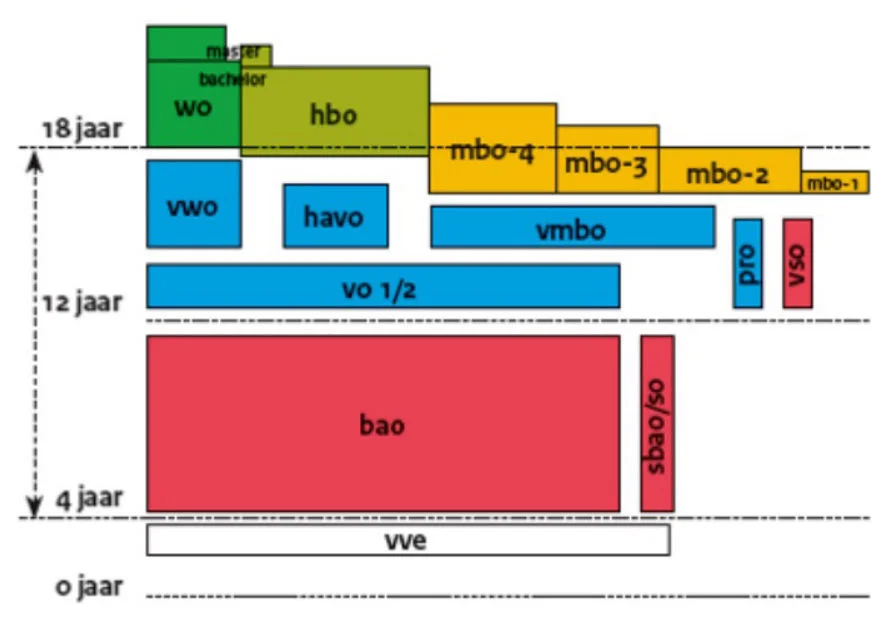
We refer to the illustration already given. We see first a period of 2 years. In fact all children receive during this period the same education. The they have to choose for vwo, havo or vmbo. This common period is introduced on political grounds but in practice children already go to a vmbo-school, a havo school or a vwo school. Therefore in practice clear differences can be met. VWO has 2 possibililities: Atheneum and Gymnasium. Gymnasium is considered as the “highest possibility” with courses in Latin and Greek.
Money

Financial aid
Financial help
The Dutch government provides a number of financial assistance programs to help low-income parents with the costs of education for their children. These programs include:
“Kindgebonden budget” (child benefit): This is a monthly allowance paid to parents of children under the age of 18. The amount of the benefit depends on the family’s income and the number of children they have.
“Studietoeslag” (student grant): This is a grant available to students who are attending secondary vocational education (MBO or VMBO) or higher education (HBO or WO). The amount of the grant depends on the student’s income, the income of their parents, and the type of education they are pursuing.
“MBO-studentenfonds”(MBO student fund): This fund provides loans and grants to students who are attending secondary vocational education (MBO). The loans are interest-free during the study period and the repayment period is ten years after graduation.
“Tegemoetkoming onderwijskosten” (educational expenses allowance): This allowance is available to students who are attending secondary vocational education (MBO or VMBO) or higher education (HBO or WO) and who have a low income. The allowance is meant to help students cover the costs of tuition, books, and other educational expenses.
In addition to these programs, the Dutch government also offers a number of other benefits and allowances that can help low-income families with the costs of raising children, such as:
“Zorgtoeslag” (healthcare allowance): This allowance helps people cover the costs of their Dutch healthcare insurance.
“Huurtoeslag” (rent allowance): This allowance helps people cover the costs of their rent.
“Kinderbijslag” (child allowance): This allowance is paid to parents of children under the age of 18. The amount of the allowance is the same for all families, regardless of income.
To apply for any of these programs, parents or students can contact the Dutch Tax and Customs Administration (“Belastingdienst”). For more information, please visit the Belastingdienst website or call the Belastingdienst customer service line at 0800-0543.