LIVING TOGETHER


Many people live alone
Many people live alone
A significant number of Dutch people choose to live alone for various reasons. Here are some common explanations:
Partner passed away: In the case of older individuals, living alone often occurs because their partner has passed away, and they find themselves without a companion.
Divorce: Divorce is another prevalent reason for living alone. In fact, approximately one in three marriages in the Netherlands ends in divorce, leading to many individuals establishing their own households.
Young people: Young people often opt to live alone as they embark on their journey towards independence. Usually couples start living together while not being married.
Living apart together: Interestingly, some people are in relationships but still choose to live alone. This decision may arise due to personal preferences, the desire for personal space, or other factors specific to their circumstances.
Family
Family is an integral part of Dutch society, with more than half of the population being part of a family unit. However, there are several important facts that have to be taken into account:
Family size: On average, a Dutch family consists of 1 – 2 children, indicating that families tend to have fewer than two children.
Divorce and remarriage: Divorce is a common occurrence in the Netherlands, and it is not uncommon for individuals to divorce and subsequently marry someone else. T
Single-parent families: The country also has a significant number of single-parent families, primarily due to divorce. These families consist of one parent (father or mother) raising the children.
Partner selection: Dutch individuals have the freedom to choose their own partners. In contemporary society, many people rely on the internet and dating sites to meet potential partners, broadening the range of possibilities in finding romantic relationships.
Sexual experiences: On average, Dutch young people have their first sexual experience around the age of 16-17. This indicates a relatively early onset of sexual activity compared to some other countries. It is worth noting that the age at which individuals engage in sexual activities can vary widely among different individuals. Sex before marriage is widely accepted.
Sex education: In the Netherlands, many parents engage in open conversations about sex with their children when they reach puberty, typically between the ages of 12-18. Additionally, comprehensive sex education is provided in schools, covering topics such as physical changes in boys and girls and information about sex.

Family
Are you married or are you not married?
“Burgerlijke staat” is a term in the Netherlands that refers to a person’s marital status or civil status. It indicates whether a person is single, married, in a registered partnership, divorced, widowed, or have another legally accepted status. The term is used official documents to gather information about a person’s relationship status.
Examples
Ongehuwd/Alleenstaand: Unmarried/Single – This refers to individuals who have never been married or are not currently in a legally recognized partnership.
Gehuwd/Getrouwd: Married – This indicates that a person is legally married to their spouse.
Geregistreerd partnerschap: Registered Partnership – This category applies to couples who have chosen to enter into a legally recognized partnership similar to marriage, but without a formal wedding ceremony.
Gescheiden: Divorced – This refers to individuals who have legally ended their marriage through divorce.
Weduwe/Weduwnaar: Widow/Widower – This category applies to individuals whose spouse has passed away.
These categories are used in official documents such as identification cards, passports, and legal forms to provide information about a person’s current “burgerlijke staat” or marital status.
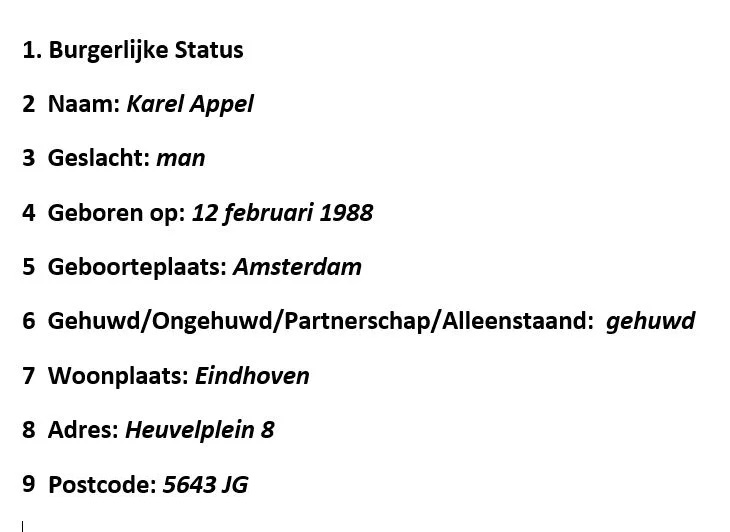
1. Marital Status
2 Name: Karel Appel
3 Gender: male
4 Born on: February 12, 1988
5 Birthplace: Amsterdam
6 Married/Unmarried/Partnership/Single: married
7 Place of residence: Eindhoven
8 Address: Heuvelplein 8
9 Zip Code: 5643 JG